
The Mythical Year Three Leap
What history tells us about quarterback development

You don’t have to go far to find a media outlet that touts Caleb Williams as one of the next superstar QBs in the NFL. He ranks eighth in MVP odds according to Vegas Insider and is projected to take a major leap going into his second season in Ben Johnson’s system and his third since being selected with the 1st overall pick.


For a QB that ranked middle of the pack in most advanced metrics last year, this is a pretty substantial jump to be widely considered a top 10 QB:
11th in ANY/A (PFR)
16th in QBR (ESPN)
16th in Overall Grade (PFF)
17th in DVOA (FTN)
17th in EPA per Play (SUMER)
41st in CPOE (NGS)
So what gives? Has Caleb Williams already shown the signs of a future superstar, or are we projecting traits that have yet to translate into elite quarterback play?
Past Precedent
Jared Goff, Mitchell Trubisky, Trevor Lawrence, and Caleb Williams share more than just being the first quarterbacks selected in their respective draft classes.
Each struggled as a rookie while dealing with poor coaching and the typical growing pains that come with playing quarterback in the NFL.
Each got a fresh start with a new offensive-minded head coach in their second season. The Rams hired Sean McVay in 2017, the Bears hired Matt Nagy in 2018, the Jaguars hired Doug Pederson in 2022, and the Bears hired Ben Johnson in 2025.
Looking at EPA per play from RBSDM, all four quarterbacks made substantial jumps in Year 2:
Goff: -0.316 → 0.201 (+0.52)
Trubisky: -0.093 → 0.197 (+0.29)
Lawrence: -0.045 → 0.132 (+0.18)
Williams: -0.026 → 0.089 (+0.12)
ESPN's QBR tells a similar story:
Goff: 18.3 → 56.3 (+38)
Trubisky: 33.3 → 71 (+37.7)
Lawrence: 39.1 → 56.1 (+17)
Williams: 43.3 → 58.2 (+14.9)
However, Year 3 wasn’t necessarily as kind to all of these quarterbacks.
Goff reached a Super Bowl but never developed into the type of quarterback who could consistently elevate an offense on his own. Trubisky regressed in Year 3 and never started more than ten games in a season afterward. Lawrence appeared poised for a superstar breakout after his Pro Bowl second season, but injuries stalled the ascent and the leap many expected never fully materialized.
Their careers followed different paths, but they shared one common thread. Their biggest developmental jump had already occurred.
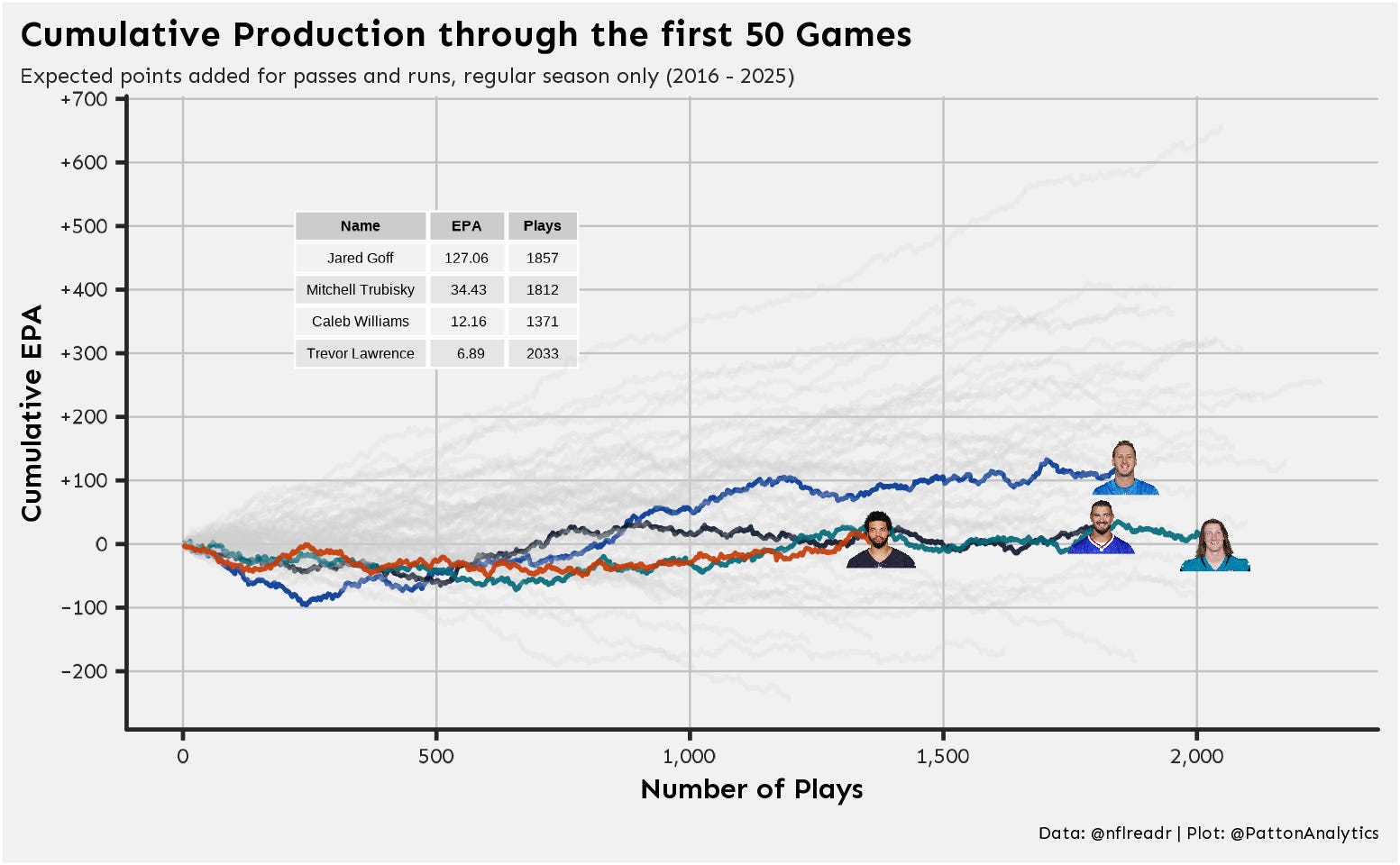
Quarterbacks who make meaningful strides often do so by the end of Year 2. The leap from struggling starter to competent NFL quarterback is common. The leap from competent starter to superstar is far less common.
The Exception to the Rule
The obvious counterargument is that Caleb Williams possesses a level of physical talent that separates him from the quarterbacks mentioned above.
Stronger arm. Better athlete. More highlight-reel plays.
In other words, the argument for Caleb isn’t Jared Goff, Mitchell Trubisky, or Trevor Lawrence.
It’s Josh Allen.
The Bills’ MVP-caliber quarterback entered the league with rare physical tools, inconsistent accuracy, concerns about playing within structure, and questions about whether he could ever put it all together.
Allen became the exception that reshaped expectations for every talented but unfinished quarterback who followed.
Both quarterbacks posted comparable sack rates through their first two seasons. Caleb deserves credit for making a significant jump from Year 1 to Year 2, dropping from 9.3% to 3.2%. Allen's sack rate, by comparison, was unchanged at 6.6% in both seasons.
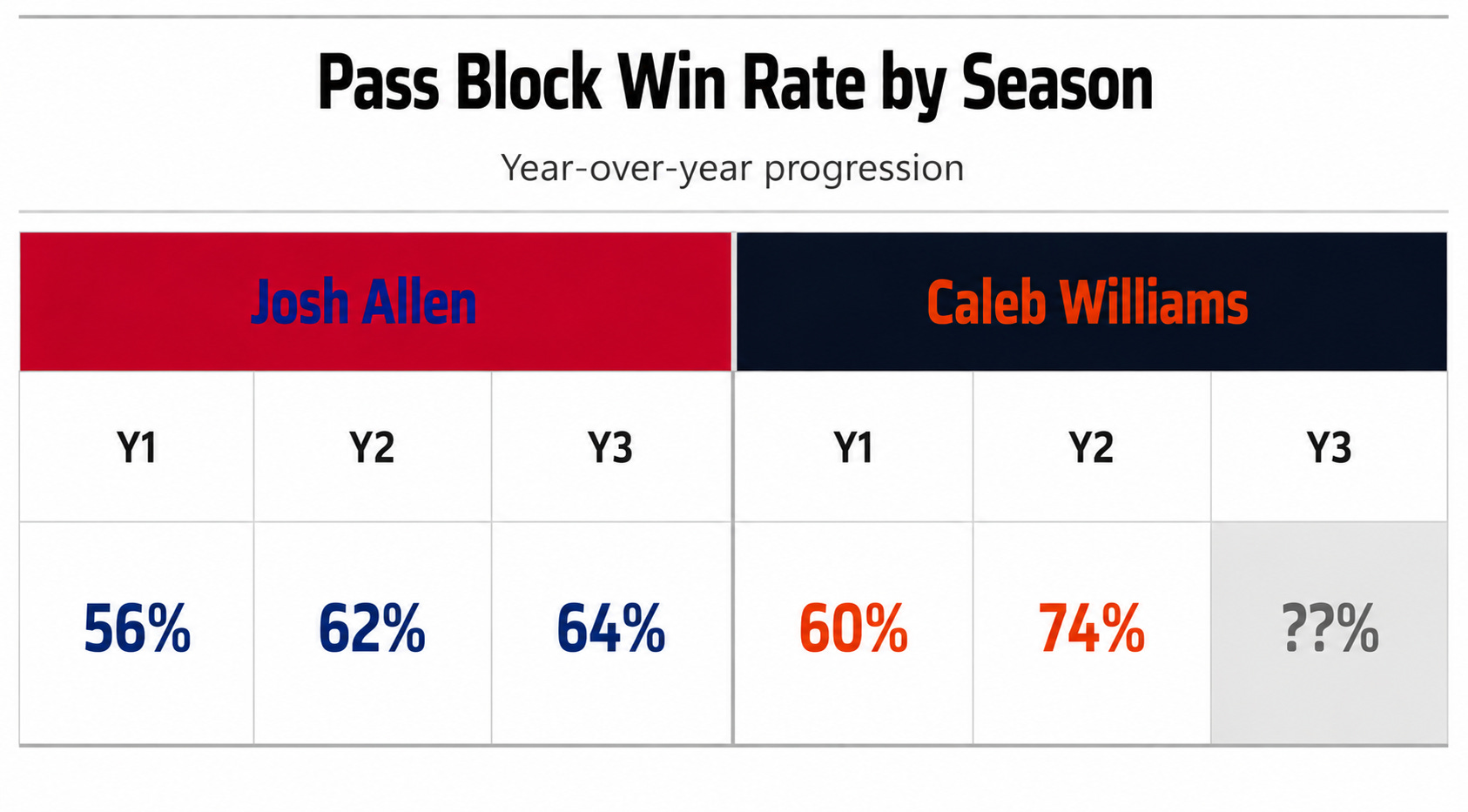
The offensive line comparison is also worth noting. According to ESPN's Pass Block Win Rate, Caleb's 2025 offensive line outperformed any unit Allen played behind during his first two seasons in Buffalo.
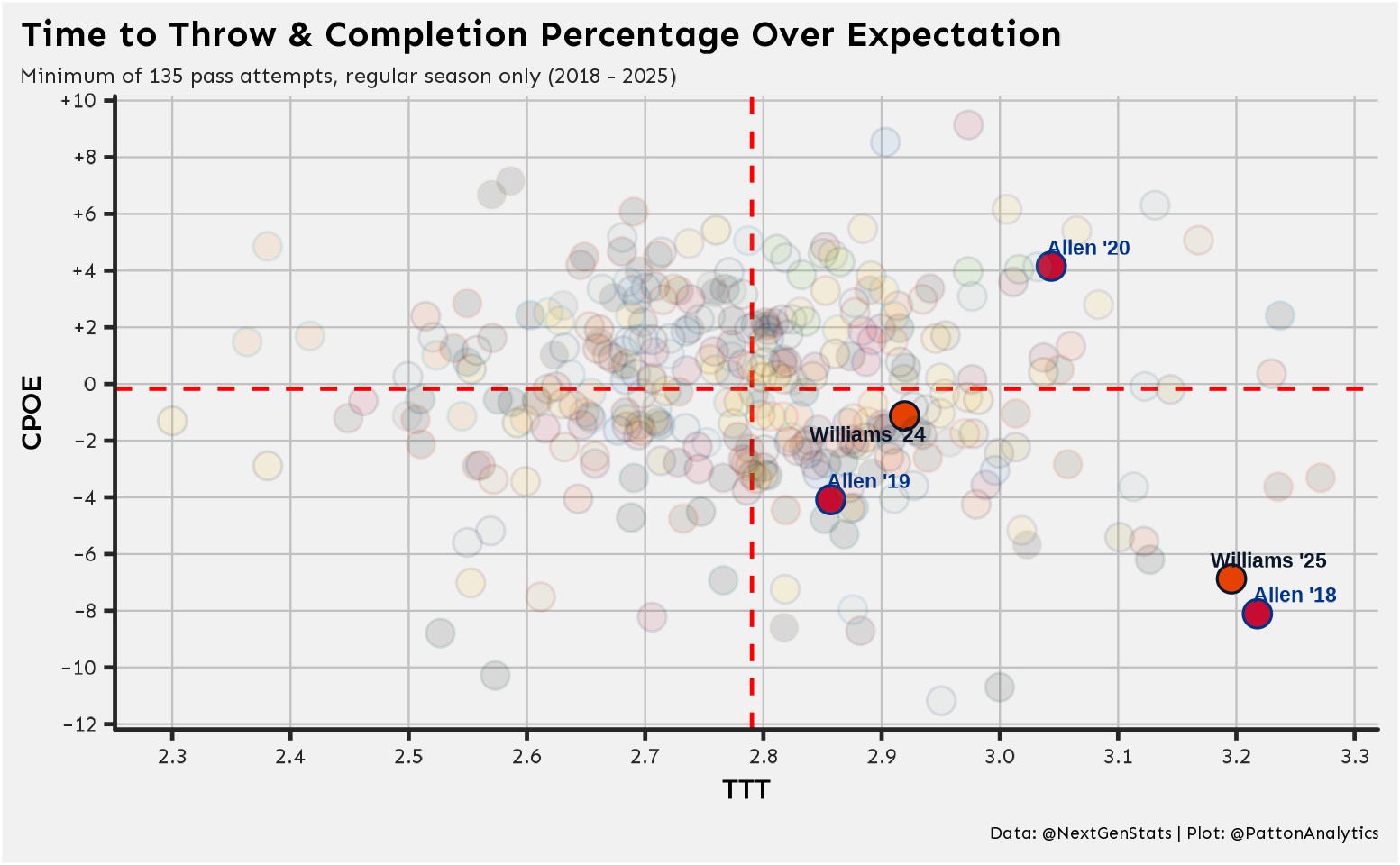
Accuracy concerns followed both quarterbacks early in their careers. Allen's struggles as a passer were well documented, and Caleb's accuracy issues generated many of the same questions. The difference is that Allen showed measurable improvement each season before his eventual breakout.
Through their first two seasons, Josh Allen generated roughly 13.9 EPA. Caleb Williams produced approximately 12.2 EPA. On the surface, their overall production looks similar. The difference is how that production was generated.
Allen generated 54.3 EPA on scrambles compared to 49 EPA for Williams. On designed runs, the difference was even more dramatic. Allen added 16.5 EPA while Williams posted -22.7 EPA. In total, Allen generated 70.8 EPA on the ground through his first two seasons. Williams has generated 26.3 EPA.
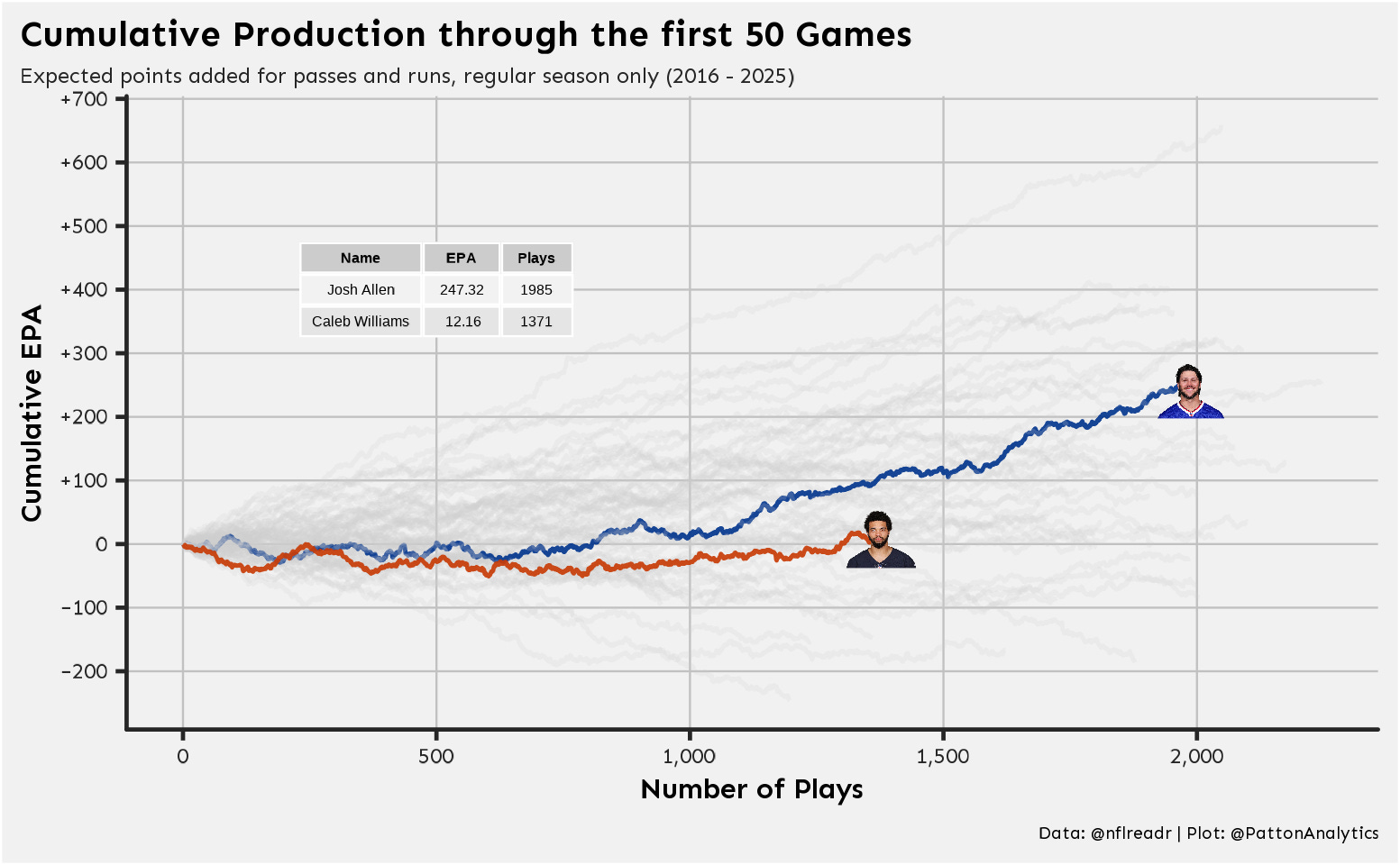
The comparison becomes more complicated once the supporting cast enters the equation. Allen generated substantially more value on the ground, yet the two produced similar overall results through two seasons.
While Allen benefited from solid offensive line play, Buffalo gave him arguably the weakest receiving corps of any quarterback discussed in this article. His primary targets included Kelvin Benjamin, Andre Holmes, John Brown, and Cole Beasley before the Bills finally traded for Stefon Diggs in 2020.
That's a stark contrast to throwing to DJ Moore, Rome Odunze, Keenan Allen, Luther Burden, and Colston Loveland. It's difficult to argue Caleb Williams has been operating with a shortage of receiving talent.


That distinction matters because the Rams, Bills, and Jaguars all made aggressive moves to acquire a true WR1 for their quarterbacks who were entering Year 3. Brandin Cooks flew into Los Angeles from New England. Stefon Diggs landed in Buffalo from Minnesota. Calvin Ridley arrived in Jacksonville from Atlanta.
The Bears have chosen a different path.
Instead they shipped out DJ Moore to Buffalo this offseason. Perhaps Rome Odunze bounces back to where he was trending prior to the foot injury. Perhaps Colston Loveland continues his ascent as a top player at his position. Perhaps Luther Burden becomes a featured part of the passing game. All are reasonable possibilities.
But projecting a major Year 3 leap for Caleb Williams requires projecting growth we have yet to see from this receiving group.
Avoiding Disaster
A big reason why several analysts believe Caleb Williams can take the leap is because of the jump he made from Year 1 to Year 2 in minimizing mistakes, going from taking 68 sacks as a rookie to less than half that with 24 sacks last season.
Avoiding negative plays is an important trait. The question is whether Caleb has translated that skill into something materially different than what we've seen from quarterbacks like Bo Nix.
Nix isn't projected to take a massive leap heading into Year 3 despite the Broncos adding Jaylen Waddle. Yet many of the same traits being used to justify optimism for Williams already exist in Nix's profile. Both quarterbacks do a good job of avoiding crippling mistakes, but neither has consistently turned that into top-tier production.
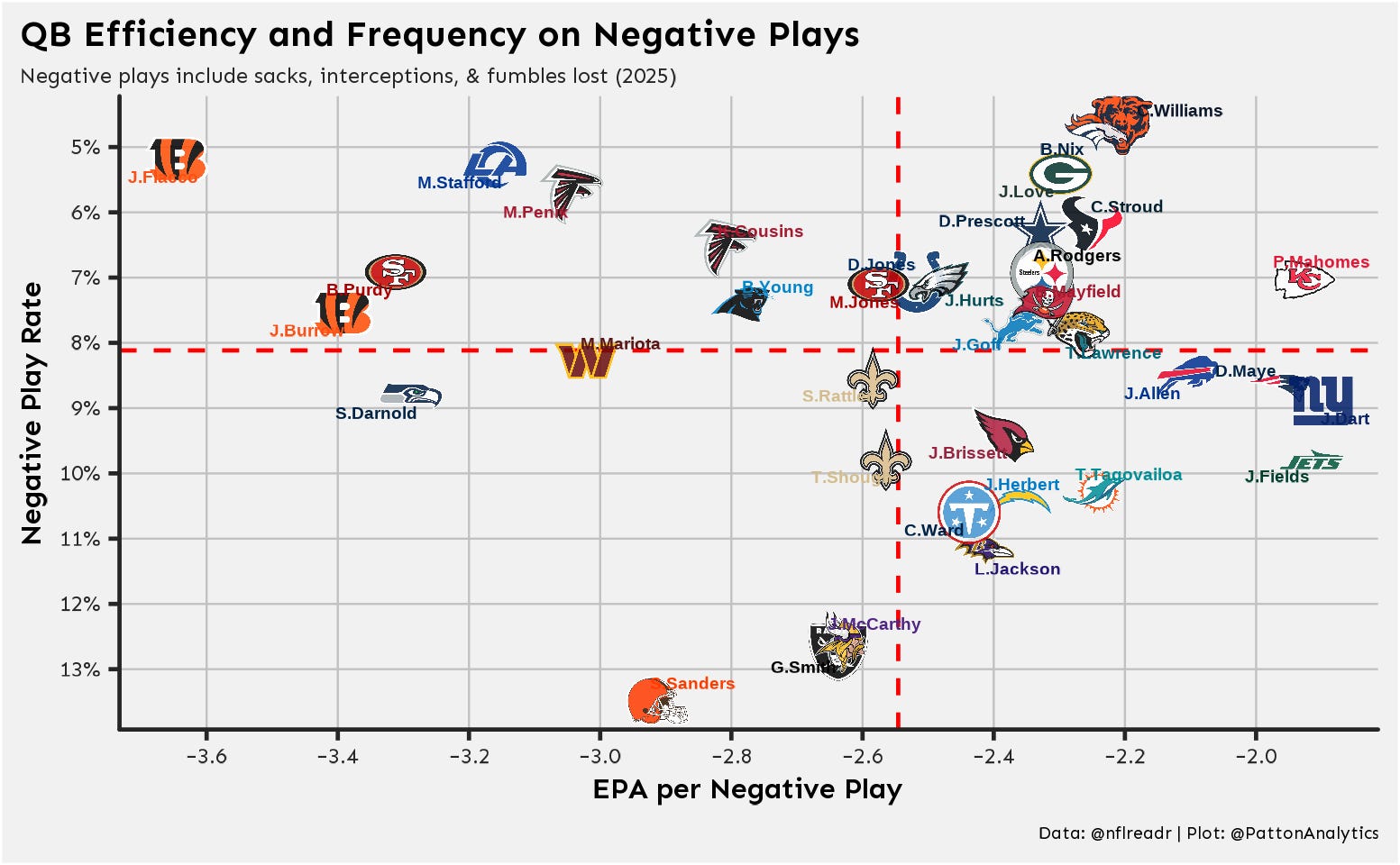
For instance, Caleb Williams has avoided sacks at the highest rate (6.04%) since entering the league in 2024. According to FTN, he’s avoided a potential 79 sacks. The next closest quarterback is Baker Mayfield with 60. No other quarterback has more than 50.
The sheer number is impressive.
The problem is what happens after the sack is avoided.
Looking at the numbers from last season, Caleb’s efficiency after avoiding a sack (-0.58 EPA) is obviously better than taking a sack (-1.76 EPA), but it’s still comparable to settling for an incompletion (-0.86 EPA) and far less efficient than taking off and scrambling (+0.40 EPA).
Avoiding a sack doesn't happen in isolation. Offensive linemen have to maintain their blocks. Receivers are forced beyond the structure of the play and into improvisation. Yet too often, the payoff is little more than an incompletion.
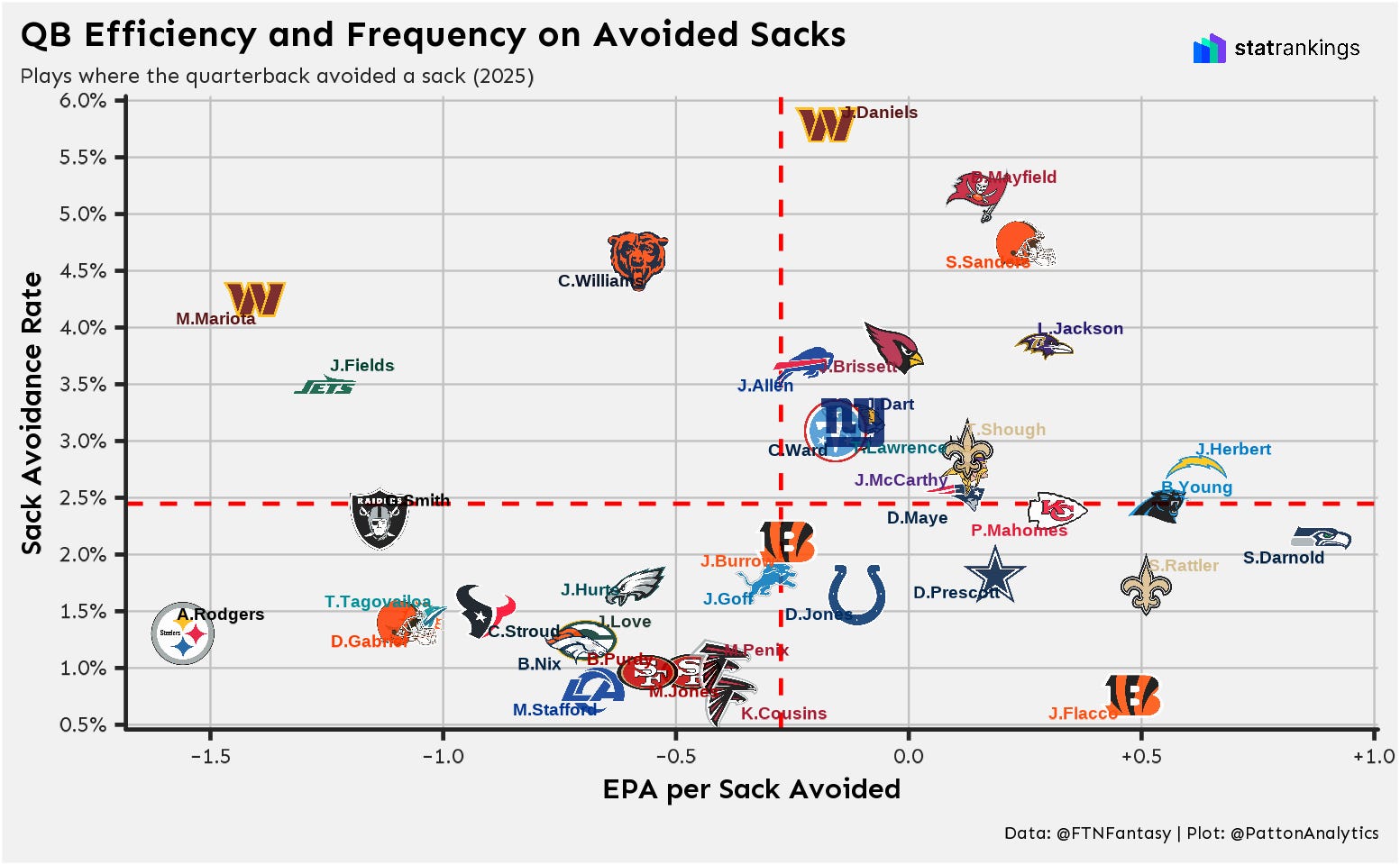
Avoiding disaster is valuable. Creating positive plays from that chaos is what separates good quarterbacks from great ones.
Caleb Williams’ statistical profile resembles Bo Nix far more than it resembles the elite quarterbacks he’s often compared to. Nix is a capable starting quarterback who does a good job limiting mistakes. The difference is that nobody is projecting Bo Nix to become one of the best quarterbacks in football.
Avoiding negative plays raises a quarterback’s floor. The question entering Year 3 is whether Caleb Williams can raise his ceiling.
Off Script
On a recent podcast, Mina Kimes and Ben Solak poured out their praise for Caleb Williams, citing his efficiency on in-rhythm dropbacks.
The problem is that “in rhythm” appears to be a fairly fluid term.
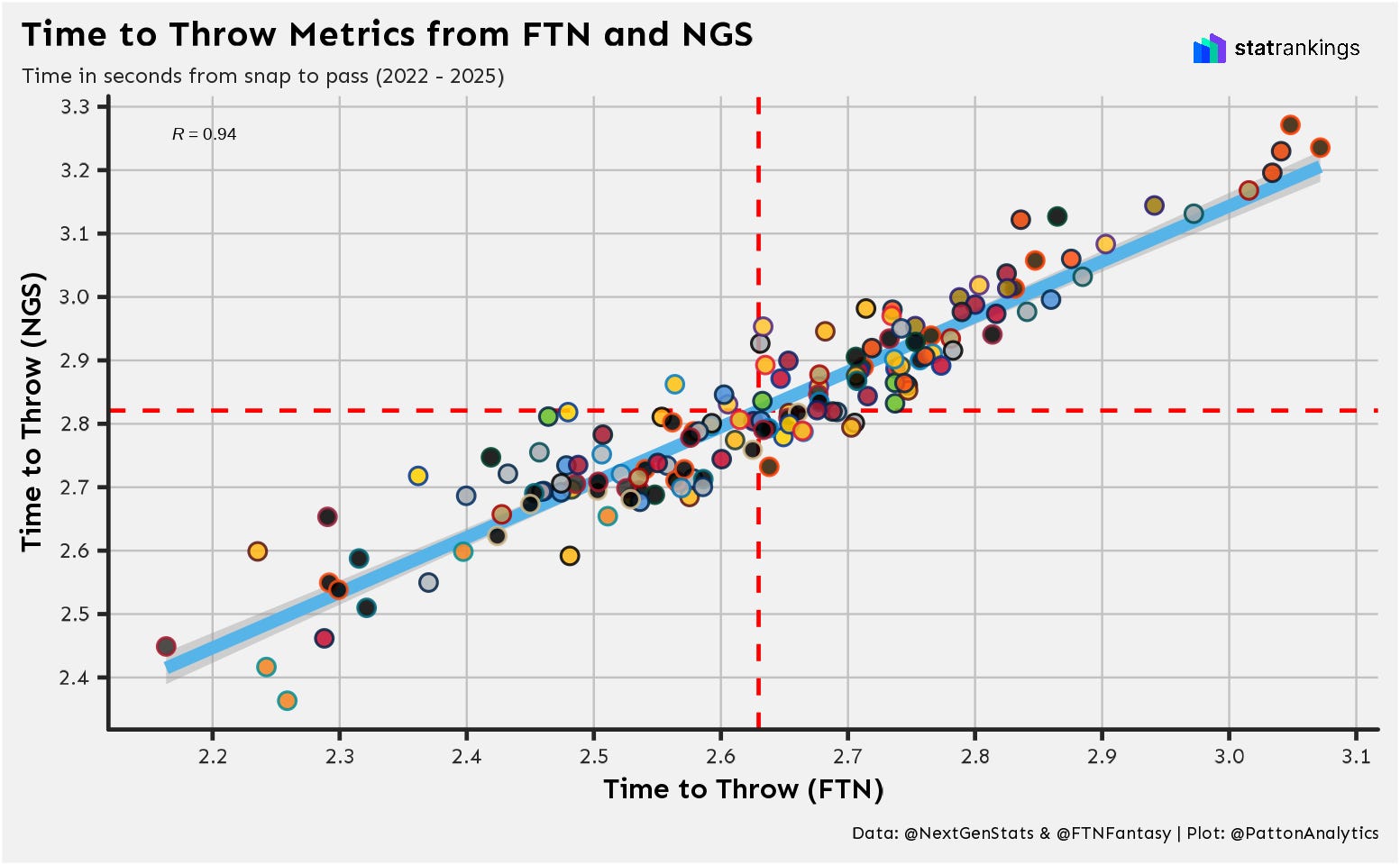
Mina Kimes defined in-rhythm dropbacks as plays with a time to throw between 2.5 and 3.0 seconds, noting that Caleb Williams ranked second behind Drake Maye according to Next Gen Stats. A few days later, Ben Solak used a broader definition of 2.5 to 4.0 seconds and stated that Williams ranked fourth behind Drake Maye, Matthew Stafford, and Daniel Jones.
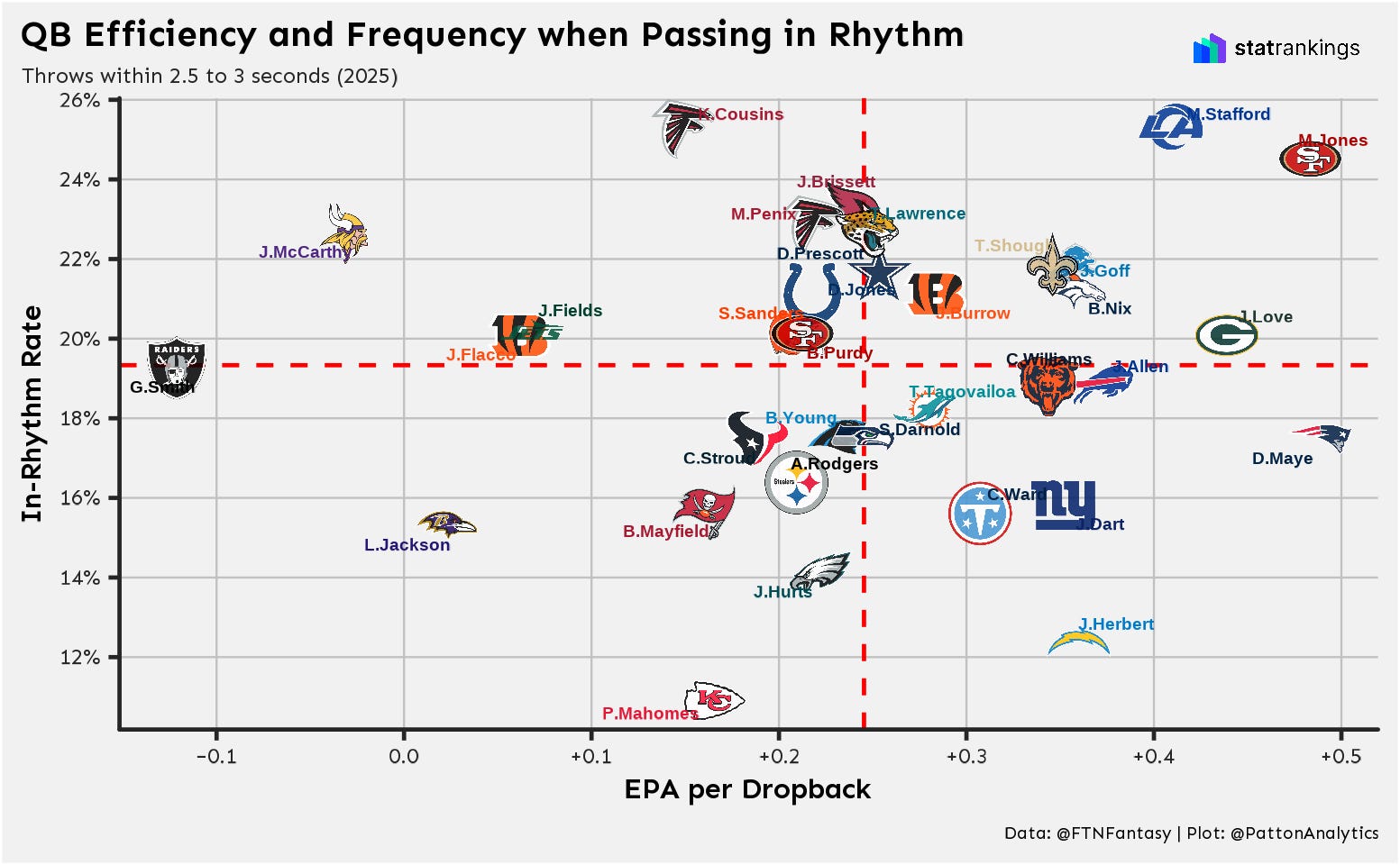
For the sake of this discussion, I'll use a stricter version of Mina's definition. Plays where the quarterback was hurried, forced from the pocket by pressure, or abandoned a clean pocket are excluded. Designed rollouts and bootlegs remain included because they still operate within the structure of the play.
Under those parameters, Williams drops from a top five ranking to just outside the top ten. The exact ranking depends on how “in rhythm” is defined. The broader takeaway does not.
Caleb Williams plays in rhythm at a below average rate. He’s a quarterback who prefers to extend plays, for better or worse.
One of the defining characteristics of Ben Johnson’s offense in Detroit was Jared Goff’s willingness to stay within the structure of the play. Goff wasn’t just efficient throwing to his first read. He found it at one of the highest rates in football.
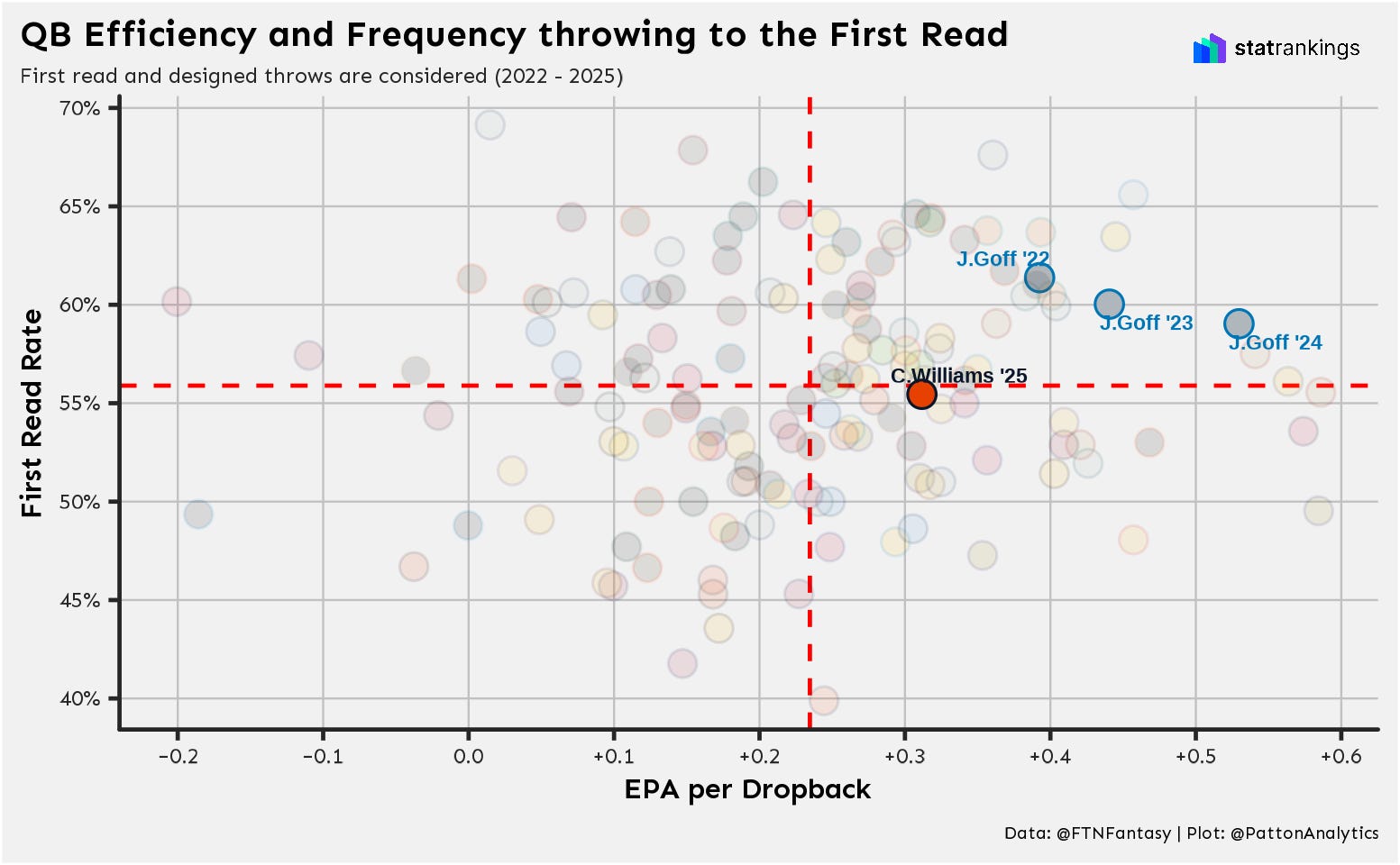
Quarterback efficiency generally declines the further into the progression a passer goes. Caleb Williams is no exception.
The league average efficiency throwing to the first read since 2022 is +0.23 EPA per pass attempt. Williams posted +0.31 EPA per pass attempt last season. On throws beyond the first read, excluding throwaways, league efficiency falls to +0.05 EPA per attempt. Williams dropped to +0.04.
The same pattern appears when looking at the public version of Completion Percentage Over Expectation (CPOE). On first read throws, Caleb Williams was nearly identical to league average. The average quarterback posted a +1.67 CPOE while Williams checked in at +1.53.
Beyond his first read, the gap widened considerably. League average CPOE falls to -1.09 on those attempts. Williams dropped to -7.18.
When the play provides an answer, Williams is capable of executing at a high level. The issue arises when he has to extend the play. Among quarterbacks from the 2024 draft class, only Jayden Daniels created outside of structure more frequently than Williams last season. More importantly, no current starter from that class was less efficient when doing so.
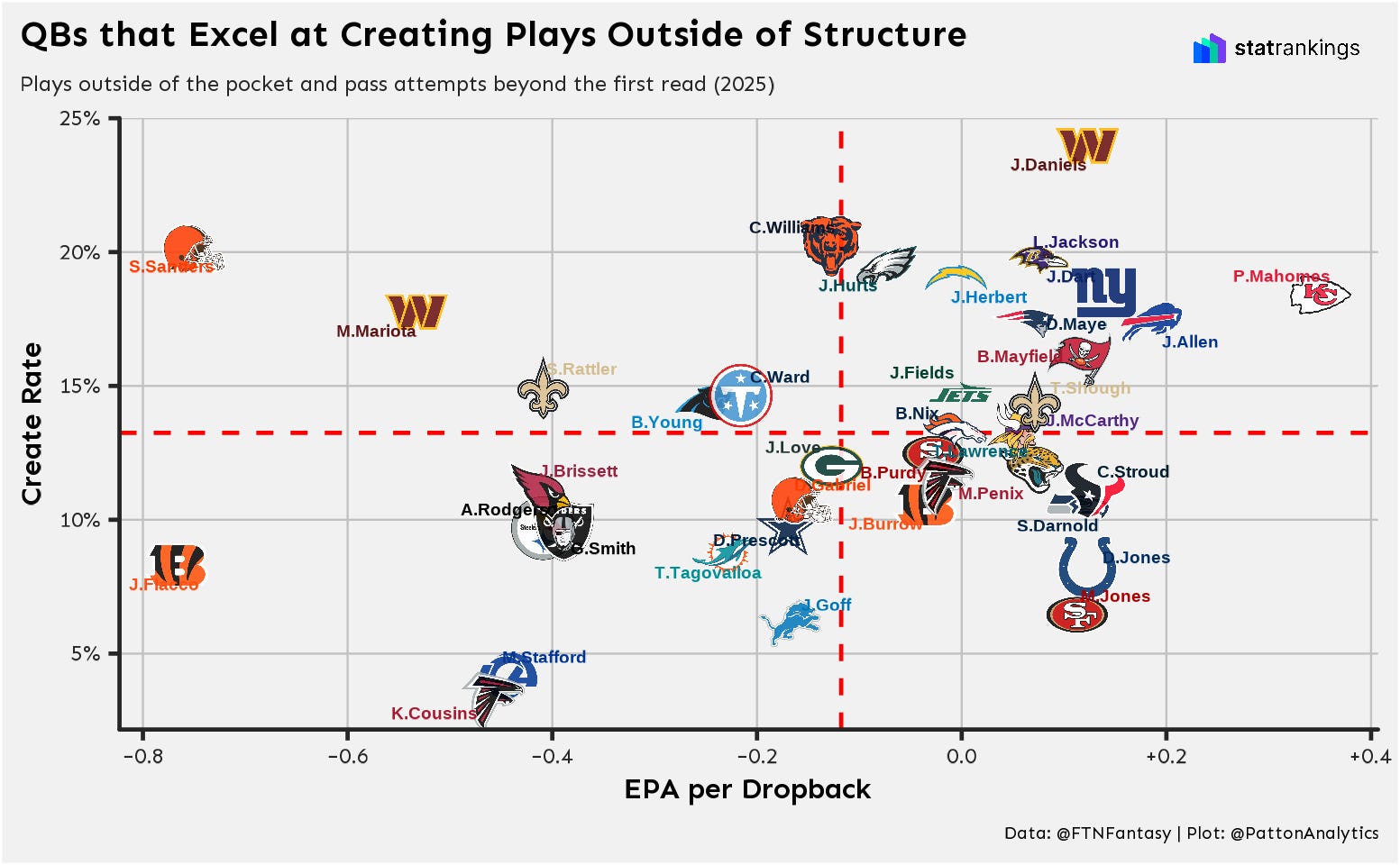
For something often presented as a defining strength, the results suggest it has yet to translate into consistent production.
Caleb Williams doesn’t need to create more.
He needs to consistently take advantage of what’s already available.
Conclusion
Every year, fans and analysts search for the next quarterback poised to make the jump from promising starter to elite franchise cornerstone. This offseason, that quarterback is Caleb Williams.
Jared Goff, Mitchell Trubisky, and Trevor Lawrence all made meaningful improvements in Year 2 after being paired with offensive-minded coaching staffs. Their biggest developmental leap had already occurred by the time Year 3 arrived.
Josh Allen remains the only blueprint who took that step. The problem is that every quarterback with rare physical tools gets compared to Josh Allen. Very few become Josh Allen. Even the Bo Nix comparison serves as a useful reminder. Avoiding mistakes is an important trait, but it doesn’t automatically make a quarterback a superstar.
That’s what makes Caleb Williams such an interesting case study. The optimism isn’t difficult to understand. He possesses rare physical talent and is paired with one of the most respected offensive minds in football.
The challenge has never been talent. The challenge is turning that talent into efficient quarterback play. Williams has shown he can execute when the answer is there. What he hasn't shown is the ability to consistently find those answers before trying to create one of his own.
For now, Caleb Williams is being evaluated less on what he has accomplished and more on what people believe he is capable of becoming.